GE FUSES: Selection GUIDE
General
General Electric power fuses are available in the indoor or outdoor current-limiting type. In the selection of GE power fuses for a particular application, it is important to consider all of the factors affecting the installation. Specifically it is necessary to know the anticipated load currents, which will available. If the problems of overloads and the co-ordination of the fuse and other protective-device operating times are encountered, it will necessary to exercise caution in the selection of proper fuse ratings to assure a properly coordinated installation.
Generally, the following important factors should be fully considered when selecting GE Fuses:
Current rating
Voltage rating
Frequency rating
Interruption rating
Location
Each of these factors, insofar as they characteristically apply to General Electric power fuses, is briefly outlined.
Current Ratings
Back to topLoad Currents
The continuous rating of the fuse must be equal, or higher than the maximum continuous load current, which will pass through it. Fuses of higher continuous ratings may be required for other reasons, such as to obtain co-ordination with other protective devices or to carry higher currents for shorter periods of time. Overloads of duration approaching fuse, melting time may damage the fuse element and change its melting characteristics. Therefore, when selecting fuse units for a particular installation, proper allowance must be made for expected overloads on the circuit. Examples of such temporary overloads include transformer magnetizing inrush currents of motor-starting currents.
Short-time Currents
Rigid rules cannot be given to cover all cases, which involve the selection of fuse units to avoid damage to the current-responsive element due to varying short-time over-currents. However, the fuse characteristics will not be altered if the over-current does not flow for more than 75 percent of the time shown on the fuse minimum-melting time curve for the value of current involved. The margin described establishes a “short time” characteristic that is useful when a fuse is the “protected” device in a co-ordination study.
Transformers
For this class of service, the power fuse selected should be capable of carrying at least twelve times the full-load rated primary current of the power transformer for one-tenth of a second in order to pass safely the inrush currents, which occur during switching operations. Other operating factors, such as co-ordination of fuses and circuit breakers, also should be given careful consideration.
Potential Transformers
The inrush current is the governing factor in the selection of fuse current ratings for potential transformers because the load currents are negligible.
Capacitor Banks
Power fuses for the protection of capacitor banks are normally selected with a rated current not less than 135 percent of the capacitor bank current. In addition, the fuses should be selected to pass inrush charging or discharging currents.
Motors
The Type EJ-2 fuse is intended to provide short-circuit protection of individual motors; power fuse units, (Type EJ-1 and IFO-1); in the higher current ratings, are also suitable for some motor-starting applications. Co-ordination of the motor-starter components and the fuses, so the fuses will be protected against unnecessary operation, is done by the motor-control manufacturer. In the selection of power fuses for a particular application, it is important to consider all of the factors affecting the installation. It is also necessary to know the motor full-load current, the motor locked-rotor current, and the overload relay characteristics to assure a properly coordinated installation.
Voltage Ratings
Back to topCircuit maximum operating line-to-line voltage should be in the range of 70 to 100 percent of fuse rated voltage. The lower limit of application is recommended because the unique current-limiting action of the fuse results in a relatively high fuse recovery voltage upon melting at rated interrupting amperes. By observing the 70 percent limitation, conservative margins are maintained between fuse maximum recovery voltages and the over-voltage limitations of various other system elements. (Exception: 600 volt-rated fuse units may be applied on circuits rated 220 to 600 volts.) Where over-insulation is required for (current-limiting power fuse units).
The fuse must be selected strictly on the basis of actual service voltage, although the mounting for the fuse can be provided with insulators of a higher voltage rating to provide additional insulation to ground.
Frequency Rating
Back to topCurrent-limiting fuse units. Types EJO and EJO-1, of ampere ratings 10E or 200E have 25/60 –cycle frequency ratings, and be can be applied on systems of 25- to 60-cycle frequency. Fuses having current ratings higher than 10E amperes have different interrupting ratings for 25 and 60 cycles. The 60-cycle ratings apply down to 50 cycles. For any system frequency below 50 cycles, the 25-cycle rating must be used.
Interrupting Ratings
Back to topThe interrupting rating of (power fuses) should be equal or exceed the maximum available short-circuit duty at the point in the system where the fuses are to be installed. A comparison can be made only if the system duty is expressed in similar terms that recognize the basis or meaning of the fuse interrupting rating.
Along with the tabulated values of asymmetrical-current interrupting ratings are corresponding three-phase mva interrupting ratings. These latter values are sometimes more convenient to use in particular applications.
If a system has little or no short-circuit contribution from motors, then a single calculation will establish a three-phase symmetrical value for the first cycle or any later time. This value forms the basis for expressing the interrupting duty for fuses as well as the momentary and interrupting duty for power circuit-breaker application. For systems of this description, a selected three-phase mva base may be divided by the source sub-transient reactance in per-unit on the same base, and the result may be directly compared with the maximum three-phase mva ratings. The fuse mva values should be multiplied by the ratio of operating kv to fuse rated dv if the ratio is other than 1.0.
Location
Back to topIndoor
For indoor installation of power fuses, the essential requirements are (a) quiet and safe operation, and (b) the non-expulsion of gas vapor, liquid, flam, or metal parts. Such a fuse is suitable for operation in an enclosure. General Electric Type EJ (current-limiting power fuses) meet these requirements.
Outdoor
For outdoor use, Type EJO current-limiting units are available. Because of the non-expulsion action of the current-limiting fuse, the installation phase spacing required is less than for other types of fuses.
Special Locations
Altitudes exceeding 3000 feet, surrounding temperatures exceeding 40 C, excessively low temperatures, exposure to damaging fumes and vapors, excessive or abrasive dust, explosive mixtures of dust or gas, steam, salt spray, excessive moisture, or dripping water, exposure to abnormal vibration or shock, unusual transportation or storage conditions and unusual space limitations.
Description
The General Electric current-limiting fuse is a precision-engineered, fully tested product which limits the initial potentially destructive short-circuit current reaching the equipment it protects to a value far below the damaging peak fault current that would otherwise flow through the system.
This current-limiting effect is accomplished by a rapid increase in resistance during melting of the fuse element. The entire interrupting operation is achieved at high speed—in approximately one-half cycle at the higher currents.
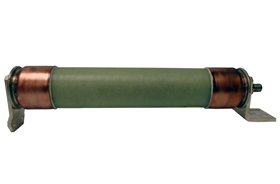
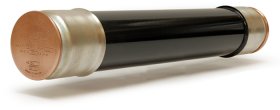
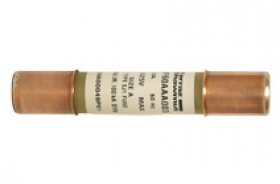
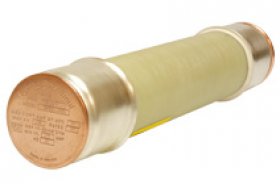
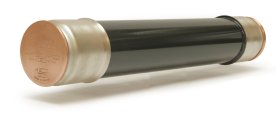
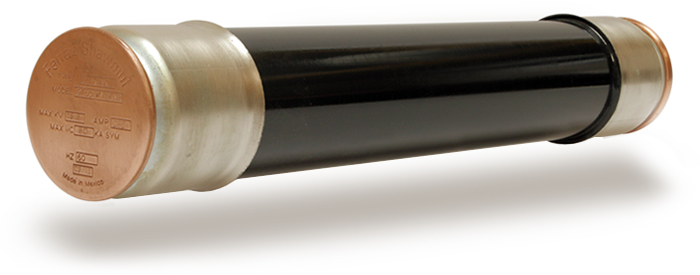
Basically, General Electric current-limiting fuses consist of one or more silver elements, surrounded by quartz sand, and enclosed in a glass or filament-wound epoxy cylinder. The quartz sand acts as an arc quenching medium. Electrical contact is provided by ferrules at each end of the fuse.
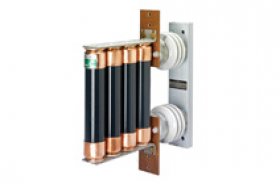
Because of the totally enclosed construction, there is no discharge of any kind during interruption, and no noise, no vents, mufflers, or specially reinforced compartments are made necessary by the fuse. Current-limiting fuses can be completely enclosed and mounted with the same electrical clearances used for non-interrupting devices of the same voltage rating, such as disconnecting switches.
Application
Type EJ-2 for Motor Protection
(Type EJ-2 fuse units) are intended for short-circuit protection of individual motors.
Protection of the motor against over-currents due to starting, plugging, stalling, and similar conditions must be provided by a separate contactor, or other switching means, and associated. Use of the fuse is thus confined economically to the high short-circuit currents where its speed and high-interrupting capacity are required for any given application, the voltage rating of the fuse units should be that for which the line-to-line circuit voltage will be less than the maximum design voltage rating of the fuse unit but greater than the maximum design voltage rating of the next lower voltage fuse unit.
Fuse units rated “60 cycles” may be used on frequencies of either 50 or 60 cycles. Units rated 25 cycles are available on application.
Ratings
“Current designations” are used to distinguish one size of fuse unit from another in the same voltage rating
Available sizes are:
| Single Tube | Double Tube | ||
| 2R | 6R | 18R | 36R |
| 3R | 9R | 24R | |
| 4R | 12R | 30R | |
Interchangeability
Type EJ-2 for Motor Protection
(Type EJ-2 fuse units) are intended for short-circuit protection of individual motors.
Protection of the motor against over-currents due to starting, plugging, stalling, and similar conditions must be provided by a separate contactor, or other switching means, and associated relays. The use of the fuse is thus confined economically to the high short-circuit currents where its speed and high-interrupting capacity are required for any given application, the voltage rating of the fuse units should be that for which the line-to-line circuit voltage will be less than the maximum design voltage rating of the fuse unit but greater than the maximum design voltage rating of the next lower voltage fuse unit.
Fuse units rated “60 cycles” may be used on frequencies of either 50 or 60 cycles. Units rated 25 cycles are available on application.
Type EJ-5 and EJ0-5 Current-limiting Fuses for Capacitor Protection
Introduction
The General Electric Fuses Type EJ-5B and EJ0-5C are special-purpose fuses designed for individual capacitor protection. The EJ5-B is designed for use indoors or inside and enclosure only. The EJ0-5C can be used in any location. The major purposes of such fuses are:
- The isolation of failed units to maintain continuity of service.
- To prevent damage to adjacent capacitors and associated equipment or injury to personnel
- To provide visual indication of failed capacitors.
Application in A-C Circuits
It is necessary, however, that the EJ0-5C fuse should always have a minimum of two capacitors of the same rating as the faulted capacitor in parallel with the operation fuse.
In applying these fuses additional reference should be made to the proposed standard case rupture curves, to determine the probability of case rupture for the particular application.
The probability of case rupture may be defined as the probability of any opening of the case as a result of failure, from a minor cracked seam or bushing seal to a violent bursting of the case. Within the safe zone usually no greater damage than slight swelling of the case will occur.
Application In Stored Energy Banks
Past experience has shown that fuse application problems in stored energy banks are peculiar to each bank. A simple table to handle such a diversity of applications would be impractical.
POWER TRANSFORMER PROTECTION
A transformer primary-side fuse is chosen to protect the distribution system on which it is installed against outages resulting from faults within the transformer, an, under certain conditions, to protect the system and transformer from faults occurring on the load side of the transformer that the secondary protective devices do not clear. There are several factors that must be considered when selecting a fuse for such applications. These include:
- The fuse must not operate or be damaged by the transformer’s inrush current.
- Under no circumstances must a fuse be selected that has a current rating less than the transformer’s anticipated maximum load current. Therefore, for forced-cooled transformers, fuse selection must be based on the higher continuous-current rating.
- Since auxiliary devices must be used to provide overload protection below 1.4 to 2 times the continuous rated current of the fuse, the fuse must coordinate with these devices in order to avoid unnecessary fuse operation.
Inrush Selection
To prevent the fuse from becoming damaged or blown on inrush a general rule is that the power fuse selected should have a minimum melt time current characteristic falling to the right of points corresponding to 12 times the transformer rated primary current and 0.10 seconds and 25 times the rated current and 0.01 seconds.
Tests and considerable field experience with General Electric medium power transformers, however, have shown that, in sizes from 301-2000 kva, the use of a point corresponding to eight times the rated primary current and 0.10 seconds should give satisfactory service. Note that due to the improved inrush withstand capability of the 9F62 fuses, care must be taken that a fuse with a sufficiently large continuous-current rating is chosen for a given transformer.
Continuous-current Rating Selection
Under no circumstances must a fuse be selected with a current rating less that the transformer continuous load current. Because fuses are of a much smaller mass, and hence thermal time constant, than the transformers they protect, they cannot be subjected to short duration overloads as the transformers can. Therefore, a transformer overload which persists for more than a few minutes, must be considered to be a normal fuse load current and the fuse rating must be selected to be equal to or greater than this current.
Forced-cooled transformers must be coordinated with fuses based on the higher forced-cooled continuous current rating. Consequently, fuses are capable of continuously carrying 133 percent of the transformer full-load current rating. Incidentally, all such fuses exceed the 12-times inrush criteria.
As outlined earlier, many interrupting tests have demonstrated the ability of 9F62 fuses to clear currents below those causing melting in one hour; it is recommended, however, that auxiliary devices be used to provide protection in the region between rated current and the one-hour current (between 1.4 and 2 times rated current, depending on the fuse ratings. It should also be noted that pre-loading the fuse carrying current before a fault) can sometimes reduce fuse melting times between 30 percent and 50 percent. This should be included when considering coordination with secondary devices, at times longer than about 0.5 seconds.
The upper limit to the size of fuse selected is a function of the desired degree of protection for the transformer from through (secondary) faults. The basic criterion, long used, has been the transformer thermal curve published in ANSI Loading Guide C57.92-1962, entitled “Short-time Loads (following full load) Oil Immersed Transformers”. The permitted duration of a fault, limited only by the transformer impedance, specified in C57.12-1973, is similar to values from this curve, so that for a four-percent impedance transformer it is two seconds (25 times the rated current), while for six-percent impedance transformer it is four seconds (16.6 times the rated current).
With the publishing of ANSI/IEEEC57.12.00-1980 and C57.12.01-1979 (standard general requirements for liquid-immersed and dry-type transformers, respectively_, the situation has changed somewhat. Transformers are now divided in four categories.
For liquid-immersed transformers in categories II, III, and IV, and dry-type transformers in categories I, II, and III, a short-circuit point at two seconds (the “two-second ANSI point”) is now often used, the current being determined by the transformer impedance. Whichever ANSI point, is used, adequate protection from through, faults is considered to be obtained if the fuse’s maximum total clearing time current curve lies to the left of this point. When a three-phase fault, occurs on a transformer, the per-unit primary current corresponds to per-unit winding current, and the “ANSI point”, or loading curve previously described, applies.
If line-to-line or line-to-neutral faults occur in a delta-delta or delta-wye transformer, then for one per-unit winding current, less than on per-unit primary line current results. This means that for a protective device located on the primary lines, the “ANSI point” or loading curve must be shifted to the left. The worst case is a delta-wye transformer with line-to-neutral fault which gives only 57 percent of the three-phase line current but with one phase of the secondary winding carrying 100 percent of the three-phase fault current.
Recent work which led to the development of a transformer through-fault current duration guide, ANSI-C57.109, suggests that the thermal curves at ready discussed are inadequate for situations where the transformer will be subjected to repeated through faults (for example, on an overhead distribution system with re-closers). Under these conditions, a mechanical withstand curve is produced by shifting the bottom part of thermal curve (for categories II, III, and IV) to start at a point given by the maximum current, limited only by transformer impedance and two seconds. The curve is then extended upward at a constant I2t. At a suitable time (category II = four seconds; categories III and IV = eight seconds each), the curve reverts to the thermal one.
The curve for “infrequent” faults (category II, less than or equal to 10 times to transformer life, category III, less than or equal to five times in transformer life) has the same form as the old loading guide curve. It is anticipated that the majority of situations where current-limiting power fuses are used will fall into the category of “infrequent”, since this is also the curve to be used when the fuse is providing backup protection to a secondary protective scheme designed to handle normal secondary faults. Note that coordination between the fuse total clearing current curve and the loading curve includes a safety factor, since preloading will shift the fuse curve to the left. (The loading curve applies to overloads following full-load current.)
For a discussion on the selection and coordination of circuit breaker trip settings, see General Electric publication GER-2766.
SELECTION OF 9F62 FUSE TO REPLACE 9F60 FUSE
Back to topAlthough it is anticipated that the 9F60 fuse models superseded by 9F62 fuses will be available for the foreseeable future, users may find it desirable to obtain, the advantages of the smaller size, improved performance, and lower losses associated with the new fuses. Selecting a 9F62 fuse to replace a 9F60 fuse requires that coordination with transformer and secondary protections be considered as outlined previously. However, in the absence of information necessary to perform such an analysis, the recommended approach is to replace the fuse with one of an equal current and voltage rating.